I am in a photographic slump, and I might as well open with that.
We were in the Rockies not long ago. I took the camera, the scenery did exactly what the Rockies do, and I went through the motions - decent light, careful compositions. People like the results. I have shown a few of them and been told they are great, and I don't think anyone was being polite about it. I look at them and find them boring. Competent, beautiful, and saying almost nothing beyond "this is how it looked, isn't that pretty?"
So I went back through the archive to work out whether I used to be better than this, and found something else instead. There was no decline to find. There was a split I had never bothered to name: sprints of street photography, landscape, documentary work, portraiture, and threaded through all of it, in every one of those years, a smaller pile of pictures where I had stopped using the camera to capture something and started using it to make something, or to show something that was not visible in the first place.
This pile is the one I still like. All of it, every time.
What that pile has in common is one of two things. Either the picture shows something that was there the whole time and stayed invisible, or it shows how a thing can look when it is seen in one particular way. That is why I gravitate towards extreme focal lengths, why so much of it ends up abstract, and why my favourite camera is one that cannot take a normal photograph at all.
A Camera That Cannot Show You The World
The camera is an EOS RP with the sensor filter taken out. Full spectrum, so it records infrared and ultraviolet along with the part of the light we actually see, and there is no setting on it that gets you back to normal. Everything it produces is false colour. You are not correcting anything afterwards, you are deciding.
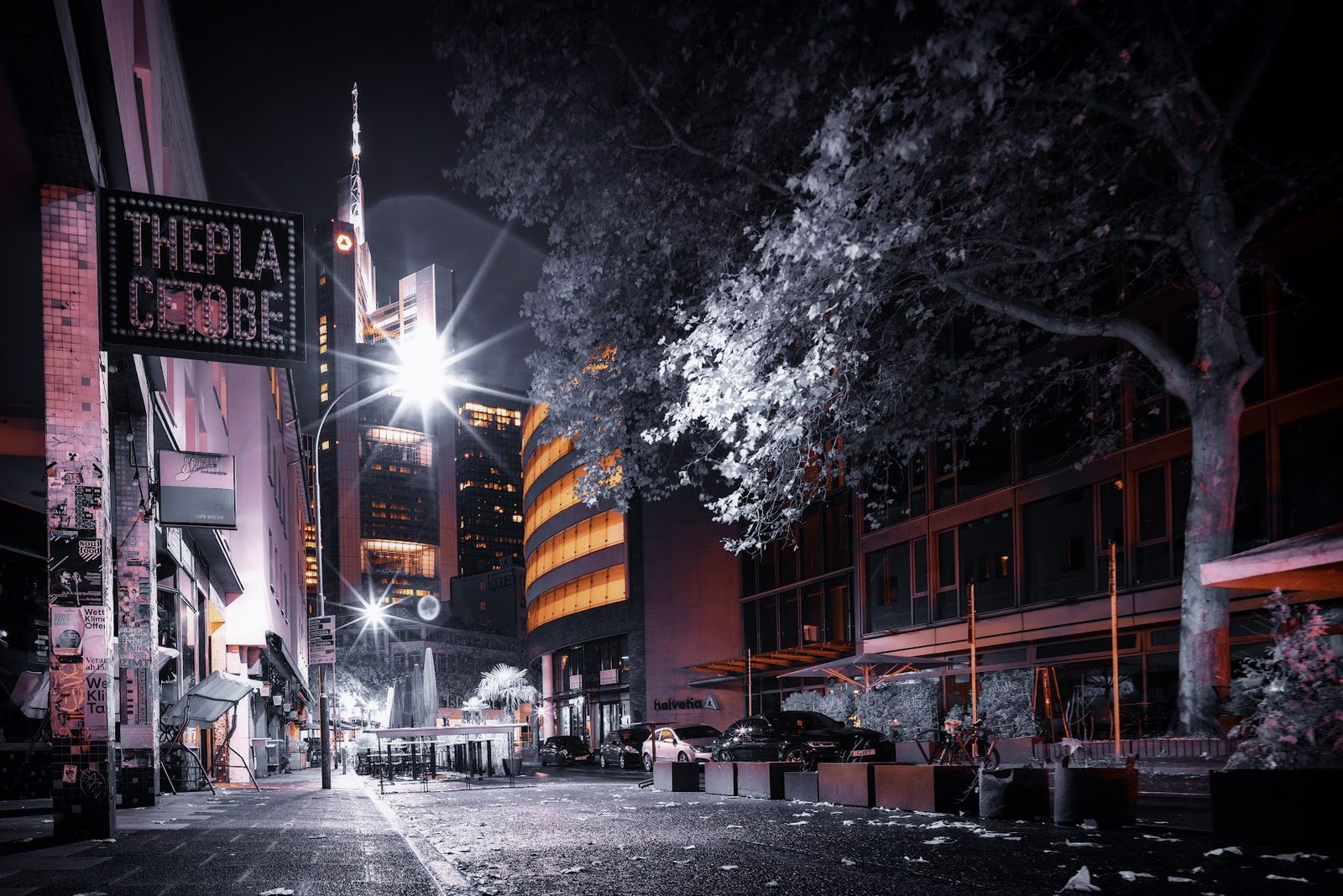
This is a street in Frankfurt at night, and everything in it was there. The tree really is that bright, in the sense that it really is throwing back that much infrared - my eyes just have no cells for it. The pink is a decision. The sunstars are the aperture. The scene is entirely legible: you can read the sign, you can find the skyline, a local would know exactly which corner this is. It is a recognisable place rendered in light nobody standing there could see.
The other way to get at something invisible is to stop the camera from holding still.
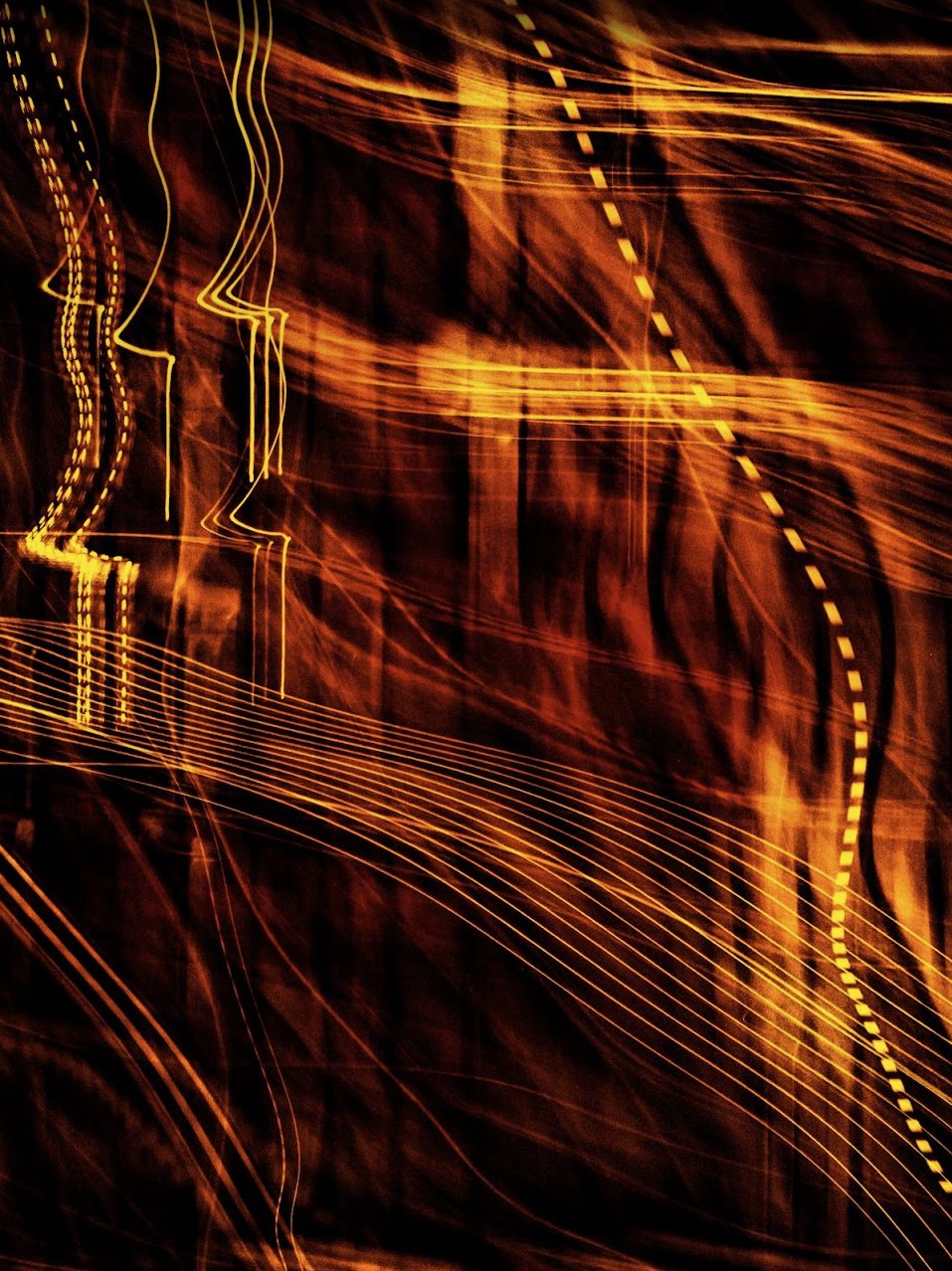
Toronto, handheld, camera moving through the exposure. What is left is the motion, which is also something that was there and that your eye refuses to accumulate. You look at a street at night and your brain smooths it into a street at night. The camera just adds it all up.
Or how about taking an extreme lens on a modified camera to create something entirely new?
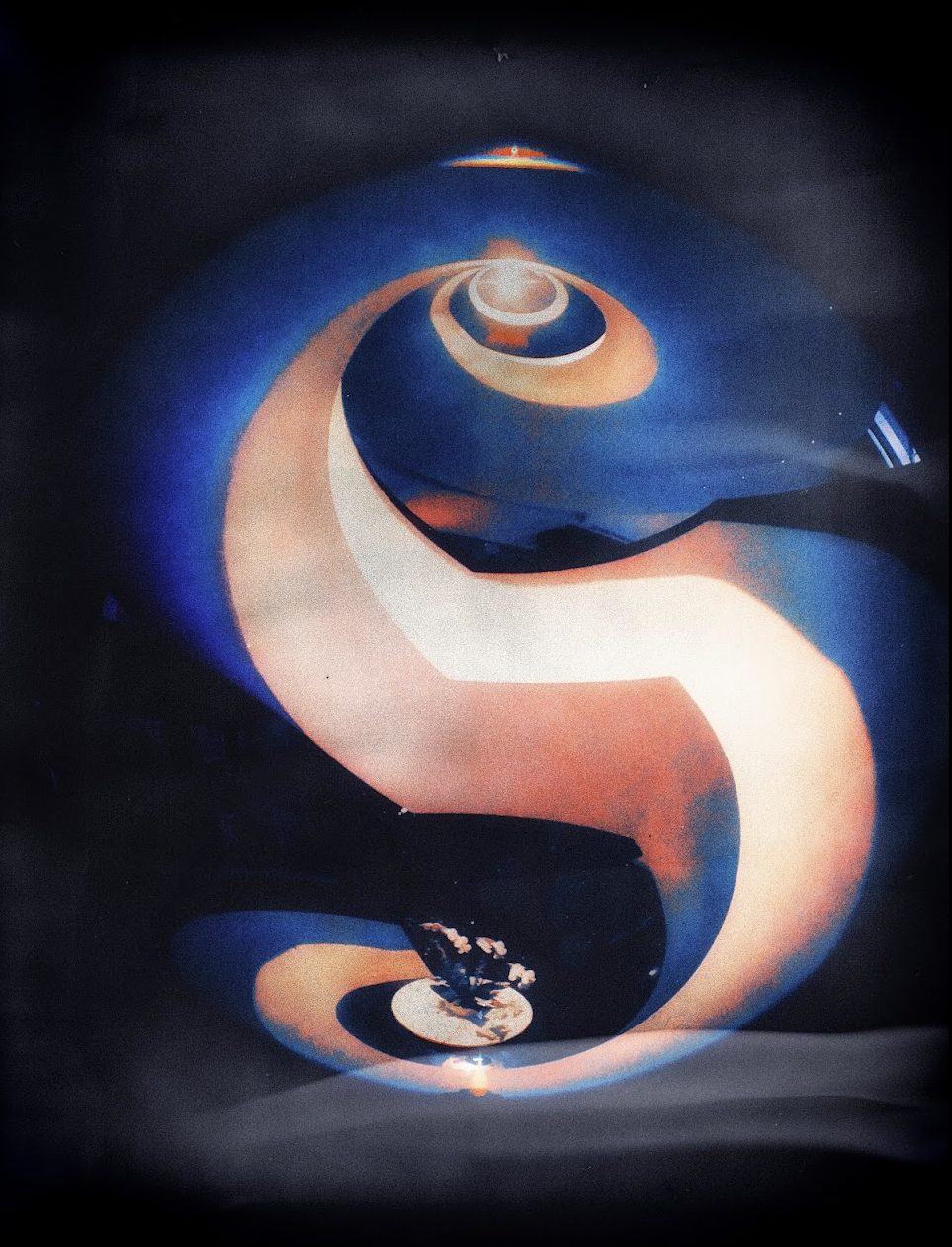
One frame, one position, nothing added. A staircase, a fisheye, infrared, and the result is the letter S in an alphabet project I have been picking away at. It is still a staircase in the sense that a staircase is what the light bounced off. It is not a staircase in the sense that nobody looking at it says "staircase" first.
The Part The Camera Didn't Do
Up to here you could credit all the strangeness to equipment. Converted sensor, curved glass, slow shutter. But photography translates to drawing with light, and these two are drawn. The cyclist is a multiple exposure worked over heavily afterwards, closer to a hand-pulled print or a piece of calligraphy than to anything I saw on that street. The world is the pencil. The camera and everything after it are the canvas.
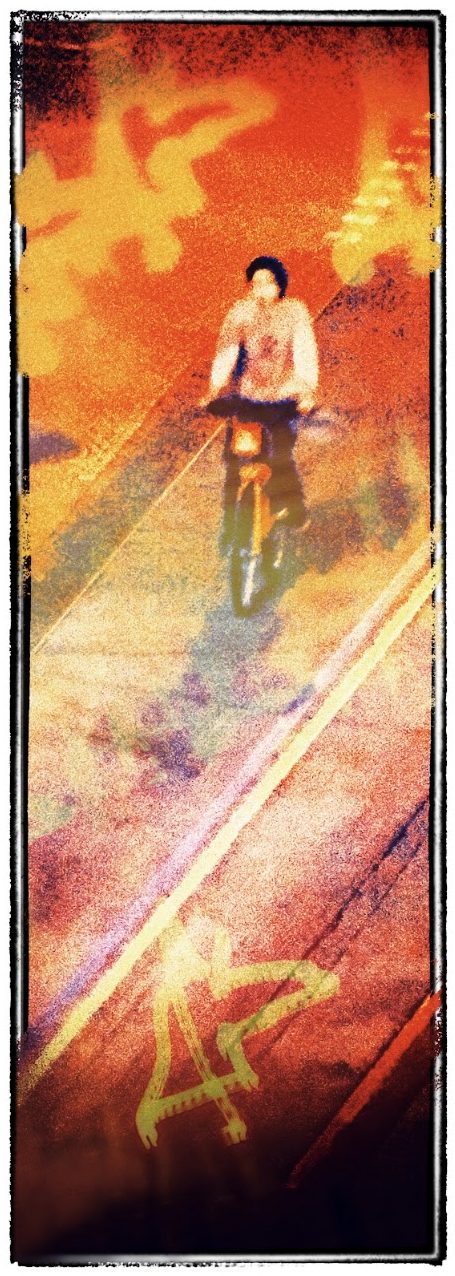
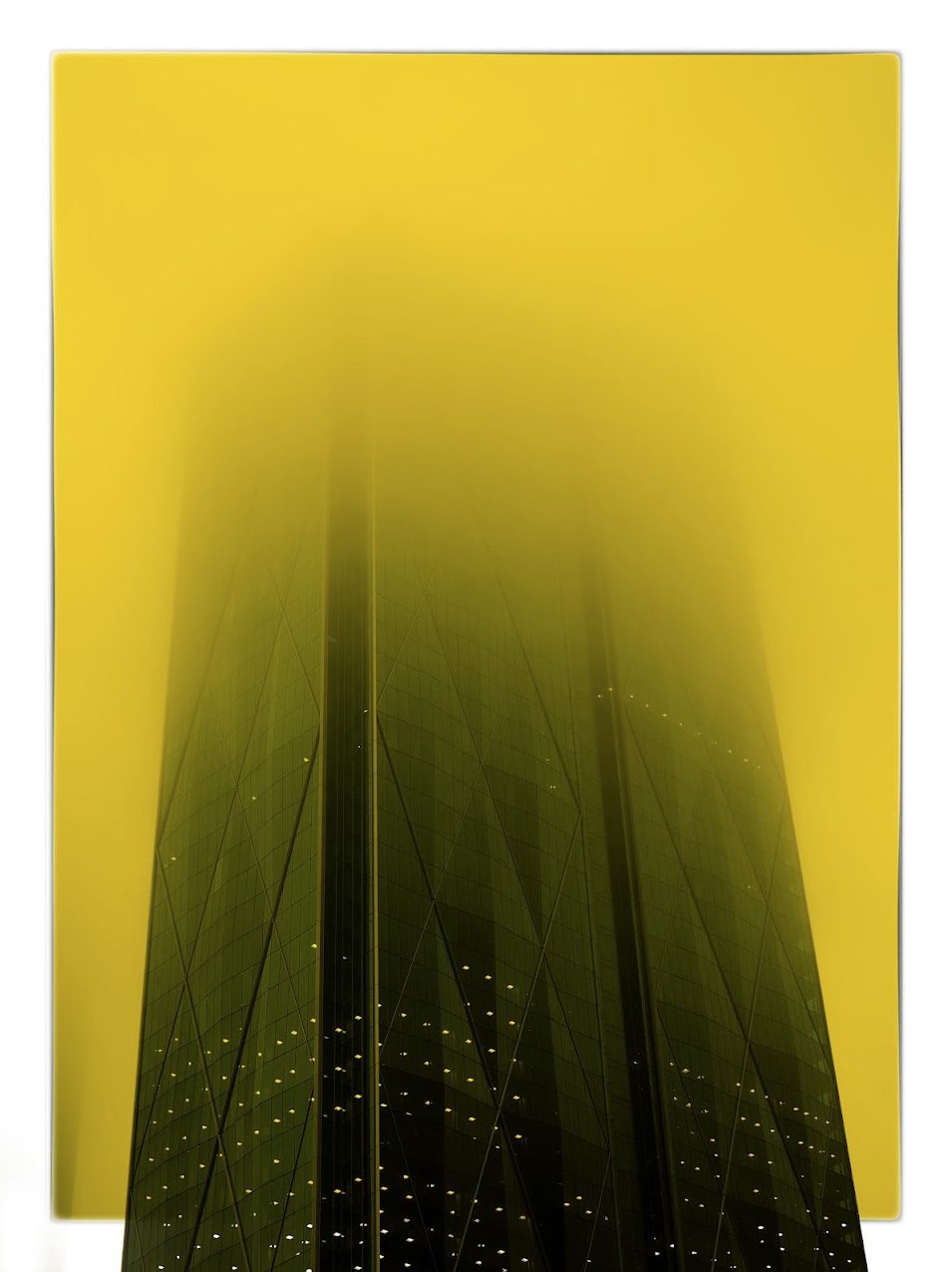
Grain that heavy is a choice. So is the ragged white border, and the flat yellow where a sky should be, and the fact that the cyclist is nowhere near sharp and I did not fix it. Sharpness is a tool and often I am not reaching for it. Sometimes a picture needs a frame around it, sometimes it needs a border inside the frame, and both of those are part of the image rather than packaging for it. The tower one is the clearest case I have: the bottom half is sharp enough to count windows and the top half has stopped existing, in the same picture, and that gap is the whole point of it.
Hockney's Complaint
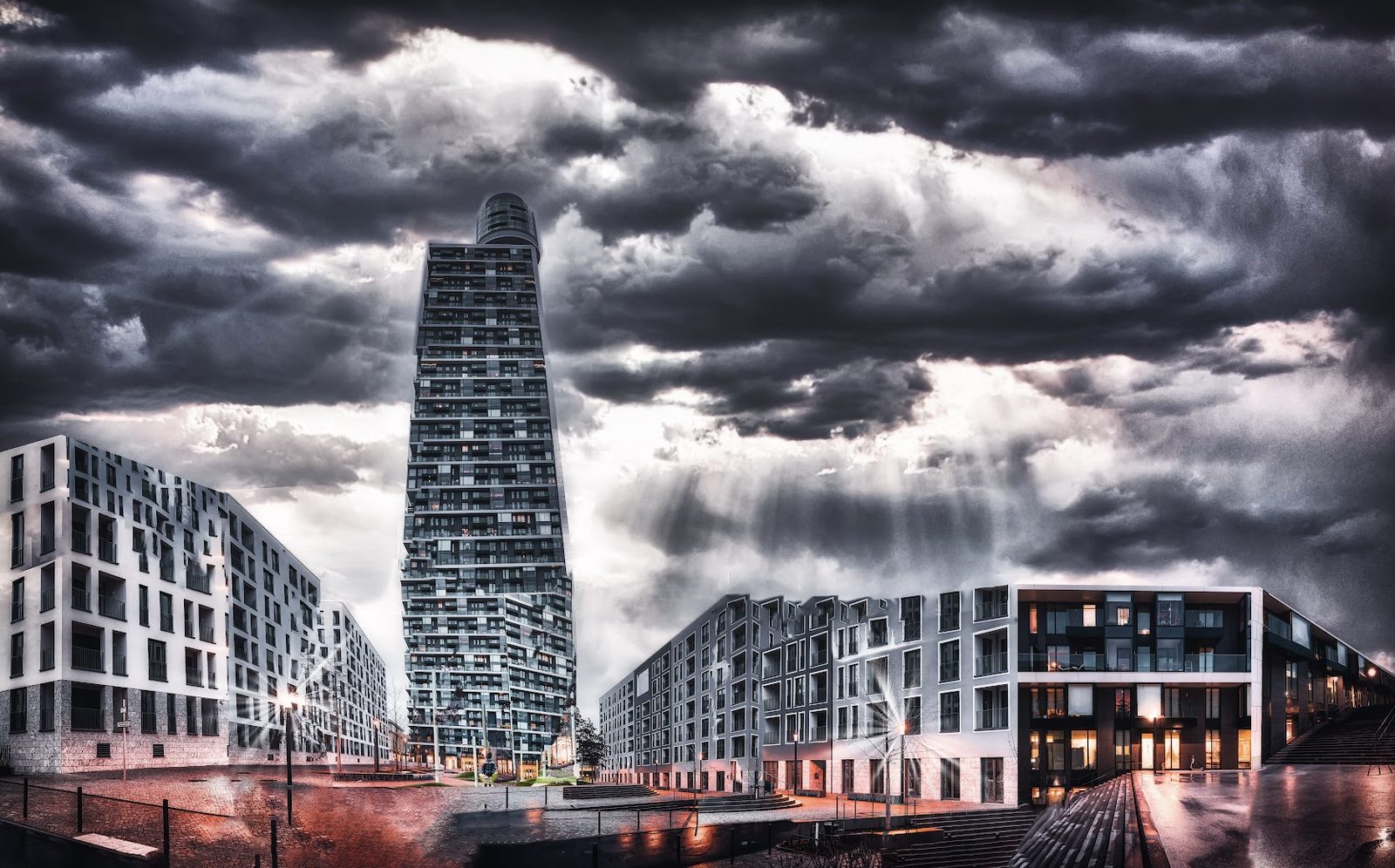
Anyone from Frankfurt recognises in this image the Henninger Turm, but this was never one photograph nor does it reflect the scene as it was. It is a pile of partial shots taken from a number of different angles and then reconstructed into a scene that behaves like a single exposure. The buildings on the left and the right both lean in ways no lens does, and almost nobody notices.
I used to call this my attempt at photographic cubism but I have gone off that description. The method is cubist enough - many viewpoints collapsed into one plane - but cubism leaves the fracture showing. Braque and Picasso want you to watch the reassembly happen. This picture hides every join and asks you to believe it, and a stitched panorama is already multi-viewpoint without anyone calling it cubist, so the label does not come free.
David Hockney is the better ancestor. His joiners from the eighties - Pearblossom Highway, the portraits of his mother - are grids of separate prints, dozens of them, each shot from a slightly different place at a slightly different time and then laid out with all the edges left in. His objection to the ordinary photograph was that it comes from one point at one instant, which is not remotely how anyone looks at anything. You look with two eyes, over time, while moving. "Perspective takes away the body of the viewer," he said. "You have a fixed point, you have no movement; in short, you are not there really."
So the Henninger Turm and the joiner are the same refusal solved in opposite directions. One hides the seams so you believe it is a photograph. The other shows them so you can't.
"Well, you're not doing photography, you're producing digital images" some of you might say, and I really disagree. All my images require the world and light to be there. I react to what I see, my camera work is always my starting point. In that sense, even in the most extreme versions like this composite, it remains photographic in essence.
In the end, so goes the saying, every photograph is an image of the person holding the camera. I wonder what this explicit remake of a David Hockney composition with me as subject says about me:
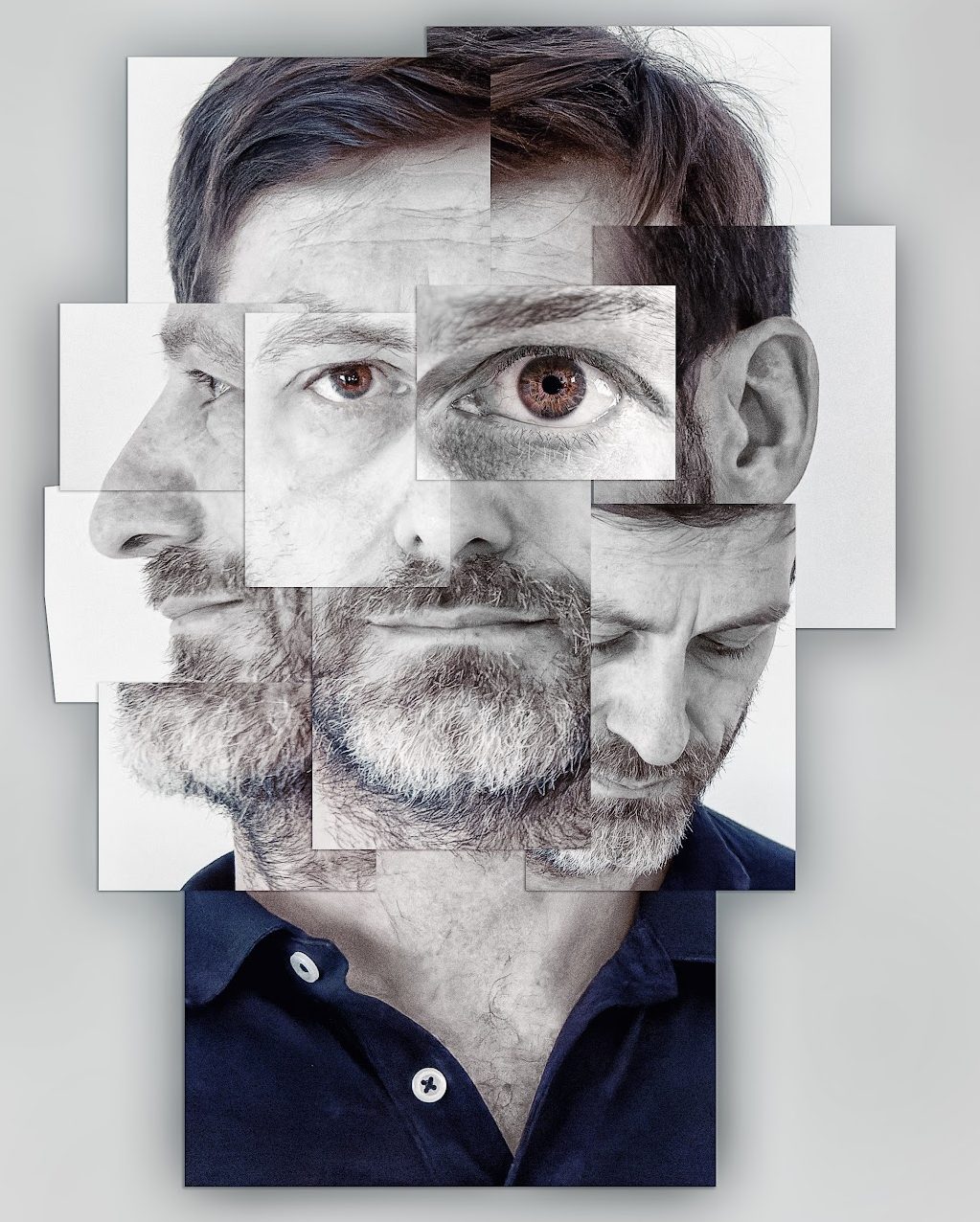
Ten shots, rendered as distinct plates. The profile at the left edge and the face in the middle cannot both be true. My eye appears twice, once enlarged well past life size and once looking down and away, and the colours were never life-like to begin with. The one plate that never got cut is the collar of the polo shirt at the bottom, and it is the thing that stops the rest of it sliding apart.
This represents me better than any straight selfie I have taken.
Which would make the Rockies pictures portraits as well. Of a man who found the spot everybody finds, stood in it, and waited for the light to do the work.
Comments
Replies come from Mastodon. Reply on Mastodon to join in.